
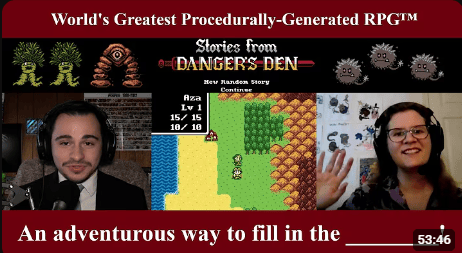
In October, I had the pleasure of joining Anthony Krolikowski on his YouTube channel to talk about Stories from Danger’s Den. We talked about how it’s going so far, the roadmap for 2027, and what I plan to add to the game prior to its release.
Here’s the video; the full transcript is below it on this page.
Anthony Krolikowski:
In the world of AI that we live in now, it’s easy to look at things being generated by the computer and think that it’s just that, and there’s not much creativity or input behind it.
But if we go back to things like Torneko’s Dungeon, which just re-came-out again not too long ago, which is an old Dragon Quest spin-off game where there was procedurally generated rooms. This is nothing new on that side and it is pretty different.
So joining me today for an interview about her game is Kathy Bunn. She is creating Stories from Danger’s Den. So first, Kathy, thank you very much for doing this with me. I really appreciate it.
Kathy Bunn:
Good to be here. Thank you.
AK:
So, real quick, just give me a quick introduction to your game, what exactly it is.
KB:
All right, so Stories from Danger’s Den is the game that generates small fantasy RPGs in the style of the early Dragon Quest games. It was inspired by — anyone who’s played Dragon Quest 4, you know, the first four chapters are basically, each one’s a short, self-contained story that, you get to meet a few characters. And I thought, what if we just had a lot more chapters, short games where you could meet someone and find out about their different goals, and help them with those, and go on a little adventure.
So that’s what this game is. It aims to evoke the feel of the early Dragon Quest games and be a comfort game and provide a bit of novelty each time because as many times as you want, you can generate a new story, or you can go back to stories you’ve been to before by entering their story ID.
Each story is about one to two hours of playtime, currently, and that’s probably about where it’s going to hold as I keep developing. But as I go I’ll work on improving the quality and variety of the stories.
AK:
Now, you mentioned 4. I played 4, 5, and 6 on the DS. I actually have my old guide books. I bought them on eBay. When I say back in the day I mean when I was maybe in middle school or so. Dragon Quest was something I really liked, especially the Monsters series.
KB:
Oh, I love those.
AK:
So you mentioned here that 4 is the one you’re kind of focusing on, but what was it about 4 that made you want to go with it compared to the other games. I think about 5, there’s the story where it comes to, you’re different ages. When I think of 9, there’s the multiplayer focus, and 10. You mentioned the different stories all converge at some point, but what really stood out for you in 4?
KB:
Well, the first three Dragon Quest games are basically, you’re a hero, you go save the world, and it’s kind of the standard hero plot. In Dragon Quest 4, you got to see a little more variety, like everyone contributes to saving the world, but they also have their own goals. That’s something you’ll see in the stories that come from this game, is you’ll get stories from a lot of different characters with different goals.
A few that I’ve made so far include… well, this one that’s showing right now on the screen is a story about a town preparing for a festival, and one of the things they want to have is the ceremonial bell–or is it a drum in this version? Yeah–that used to ring in the festival back in the days when they lived in the great city that they used to live in, that they got chased out of by monsters. So we’re storming the castle, so to speak, or sneaking in, depending on the player’s style, and getting back that relic from former days.
And there are other stories where we’ve got an adventurer who wants to take up music, so they’re looking for a musical instrument and signing up for music lessons.
And there’s another story where you’ve got a character who wants to start a library, so they’re saving up money to buy a building where they can make the library.
And there can just–there’s a lot of different possible stories. It’s not always the same thing of, okay, here’s a hero; they’re going to save the world today. And there’ll be plenty of save-the-world stories, too. But again, I’m going to try to have the variety where there are different types of antagonists and different types of heroes, and different types of worlds they end up in. And plenty of mix and match of all of the above.
So that’s one of the things that’s unusual about this game is the generated story trees. You know, random terrain generation is–a lot of games do it, and I think this game is doing it well on the overworld. There’s still more I want to do with dungeons to make it better there. But story generation with good old-fashioned procedural tools, is something I’m trying to do with this, and something that’s a bit of a challenge.
It works kind of like… are you familiar with Mad Libs, where you’ve got a book of basically fill-in-the-blank funny stories? This works kind of like that.
AK:
Yes, I wasn’t a big Mad Libs kid, but… that’s cool.
KB:
It’s Mad Libs Quest, is another way you could think of it.
AK:
Kind of like when you put in the words for the adventure, and then the story reads out. And it’s all fantasy here.
KB:
Yeah. I am aiming for sort of a–there are a lot of different worlds, but they’re all sort of the classic fantasy setting where there’s plenty of magic, plenty of bad guys to defeat, and there might be a little bit of ancient technology, but it’s not sci fi by any stretch.
I’m just going for something that you can kick back and play it, and if you need to get up and do something, you can step away from the game at any moment, and it’s supposed to be very friendly to the busy lives of adults who, as children, enjoyed these games.
AK:
I saw the one X post you put up or reshared and it was about, you used to have 8 hours to play a game, and now you have 45 minutes to play, 25 of that is spent downloading the game, you play for 20, and then you get ready for work the next day. And I can definitely relate to that with how busy life can be and even work-life balance at home, and just the non-stop of it all.
But one thing I want to dig in a little bit here, with… just making sure I got it right. So, when it comes to what’s being generated, and what’s not, is it that the stories you’re writing themselves, and that it’s generating the terrain and the different maps around them, or is it generating stories as well? What is the line there?
KB:
Okay, so here’s how it works. I write sort of story outlines, that are like the fill-in-the-blank stories. And also, well, there’s main stories and supporting quests. And those main stories and supporting quests can mix and match with each other, based on items that are needed for the main quest, based on themes of the main quest.
For instance, this one, which the town’s preparing for a festival. That’ll throw the festival theme in there, so sometimes a supporting quest you’ll get for that is somebody’s making a soup for the festival and they want you to fetch an ingredient to help complete the soup. So, those are the kinds of ways that the game randomly assembles stories with their supporting quests so that you get sort of a full experience that feels cohesive.
AK:
How long have you been working on this project? I know from looking back on your website, I saw a post going back a few years, and I know right now you have a closed alpha going on. But what has that timeline been for you?
KB:
Hoo boy! So, I used to be a homemaker and did this as sort of my creative outlet when I got a few minutes where the kids didn’t need somehting, or you know, when the kids were to bed. And now the kids are in school, but I have a day job full time, so anyway, I’ve been working part-time on this since 2020.
I think this is a pretty common story among game devs is, the pandemic hit, they were stir-crazy, they were restless, they wanted to do something new. So they started making a game. So, I’m one of those.
AK:
That’s certainly a lot more than what I can say when I had the pandemic hit here in New York. I was in 12th grade and then eventually went into college, and I sat inside and played League of Legends all day, and then eventually went back to my minimum-wage job. So I was not as creative during the pandemic.
KB:
Understandable, though. Yeah.
AK:
Now, with your background here, I know you mentioned being a homemaker, and now you have–is it a full-time job, you said?
KB:
Yes. I work as a software engineer.
AK:
So you have a background in this sort of already. So this was, you went to school for software development, and then gaming was something that you just picked up on top of that, or how did that come to be?
KB:
Yeah. So, I went to school with a computer science major, and I got a mostly-full-time sort of contract job pretty soon out of college. But when I had my first child, I put down my job to raise my children, but I still did these projects on the side. My brother was working on developing a game, and that one’s going very slowly now because he’s thick into working as a doctor and he’s got his own family, but anyway, for a time I was helping him develop his game, and I was using RPG Maker, and that’s also what I’m using to build this.
RPG Maker is great because you can approach it with no programming abilities. You can use stock art and music that ship with it. But also if you have the programming, art, and music skills, you can use those to make the game even more your own. So I’ve been applying my programming and art and music skills to this. And the music is actually about half mine and half people I’ve commissioned.
AK:
I saw on your social media page some of the songs and the editing software you’ve been using to put together, and what has been the most fun process of this? Do you like the coding aspect? I know you mentioned with RPG Maker you don’t technically need coding, but I’m sure the procedurally generated part of things requires a little bit more effort on your end.
KB:
Oh, for sure. That’s where coding comes in.
AK:
What’s your favorite?
KB:
Um. My favorite? Well, that’s a tough one, because I like all the things, but what I end up spending a lot more time on for this project is the programming. But it’s very satisfying to build these things and then see what comes from them.
I found as I was going along, that getting the maps to generate, I used Perlin noise to make that happen. That’s a very useful random generating tool for terrain. I just tweaked various things about it, and added some autotiling code that my brother had developed, which he was kind enough to make available to my project. I worked on adjusting it, and later adding rivers and things, until it gave me visions of Alefgard. You know, won’t rest until–and really, there’s still a lot to do, but I’m pretty happy with how the overworld is looking.
But I tell you what: buildings–large buildings and towns, those have been a lot harder to make, just wrapping my mind around, okay, how am I going to make these buildings look good? I ended up settling on–you won’t see it here in this dungeon map so much, because I haven’t gotten to it yet, but the towns use this. I take building and room templates. I sort of make them by hand, and then randomly select them and rotate them to face the streets in the towns. And in the case of large buildings I’ll be rotating those templated rooms to face the halls, and then drop people into it. But getting blueprints set up to copy and paste properly, and people to trop into their places properly in towns and in large buildings has been a long and difficult process. It’s taken, frankly, years at my pace. But it’s getting there. It’s getting there.
So yeah. A lot of work goes into programming, more than 90% of the work in this game is programming. But I’ve also really enjoyed making the art. For me, working on art is kind of intimidating, but once I get started I can flow with it and then I can make some palette swaps of some of these monsters and get some more mileage out of them that way.
AK:
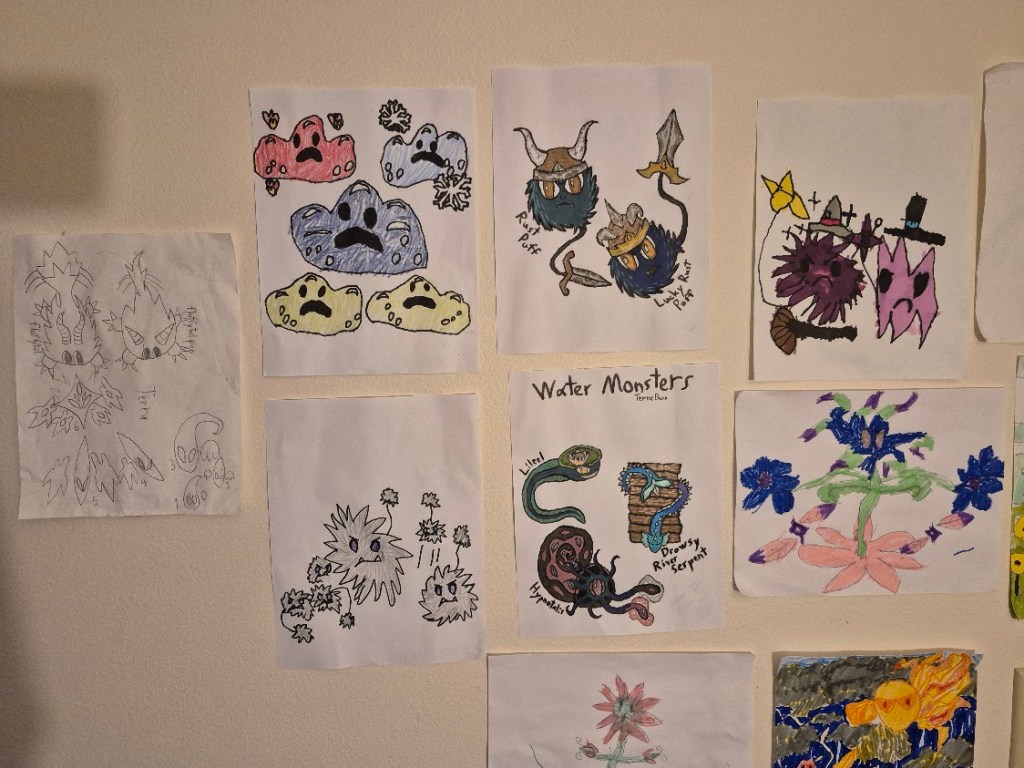
I know you wanted to talk about, earlier, the impact your kids have had on this project, so I wanted to give you that chance. I’ll bring you out so you can tell me what’s behind you.
KB:
Yeah! All right, so…I’ll try to bring you a little closer so you can see it without pulling any cords. Not sure how well you can see that, but…
AK:
It looks good. Yep, I can see that.
KB:
They made some art for the game. Some of these are fan art of stuff I’ve already added to the game, and some of it is concept art of things that I’m going to add to the game. I don’t think Rust Puffs showed in that story that was running in the background, but those are one that my older daughter, Terra, she’s 13 years old now, she designed the Rust Puff, a little puff ball guy with a rusty helmet on his head and a rusty dagger in its tail. She designed it, and I drew it in pixel art and added it to the game. It’s a lot of fun to have that connection with my kids. There’s actually all these monsters they still want me to add to the game, and I’m saying, “Yeah, I want to, but there’s this other thing I’ve gotta finish first. So, you know, all in good time.
AK:
You spend a lot of time on this.
KB:
It’s good to have their contributions because it’s going to take a lot of creativity and a lot of different types of monsters to make this game feel complete, so that each playthrough feels different. You’ve got different monsters you’re fighting, different music plays in the overworld, you know, there are a lot of vectors where variety is needed.
AK:
I certainly have a lot more questions about, when it comes to how the flow works, and the progression, and all of that. So I want to take a little quick break, and then I’ll have a lot more to ask you. So, we’ll be right back.
KB:
Sure, yeah.
AK:
Now that it’s just us, first, thank you for watching this interview series that I do independently. I was actually a few minutes late to this interview because my headphones…uh… the little fuzzy thing blew out. They’re like 6 1/2 years old. So it was time to switch these out. I’m surprised I actually kept them in a safe place and was able to put them on. Well, I was actually was able to put them on; my husband had to help me out with that.
But if you enjoy this series that I do, if you want to consider donating to it, I have the coffee, Ko-fi, the Kofi link, whatever it’s called, it’s going to be in the description of this video and also the description of my YouTube channel podcast playlist thingamabob. And if you want to sponsor one of these episodes, you certainly can. I’ll even make the ad for you if that’s what you want. Sounds like a good deal if I’ve ever heard of one myself.
We talk about Dragon Quest a lot in this episode. You’ve heard it already, and I am planning on livestreaming the Dragon Quest Monsters Withered World game when it comes out in December. I’m going to play the demo at some point, too, because you can carry over like eight monsters to the main game.
So, always follow me along on TikTok. I do have a Twitch account. I haven’t streamed on there too often, but I might pick that up again and do some dual streaming action. And I will have the full things, of course, posted on YouTube. Lots of ways to watch, and have some fun with me here. Thanks for watching along with what I do, and we’ll get right back to that interview.
AK:
All right. Welcome back. So next, as I was alluding to, I want to talk a little about the progression maybe between some of the runs that you have or going from story to story. What exactly does carry over, or does anything carry over? I know there might be the character that you’re playing as, or maybe some key items, anything like that that’s going to go from one run to the next.
KB:
That’s a good question, and you know, carryover is something I’ve thought about, and I’m honestly not sure yet. It’s a difficult thing to carry over between runs when there’s a lot that could go into each generated story.
What I do know is going to carry over is… let’s see. When you start a story, it’s going to be added to your library so that you can easily revisit it later by looking it up. When you complete a story, it’ll get a little badge of completion in your library.
As for characters and usable in-game items, I don’t think that’s in scope right now, but I like the idea of possibly having some stories have sequels or sort of crossovers or convergences, but I haven’t figured out how yet, with the way I’m building these things. So I’m going to say that’s not currently in scope.
But another thing that could carry over is the bestiary. If you defeat a monter, then that gets recorded as defeated and that can go towards an achievement, I suppose. Same with hearing music. Those are things that would not be too hard for me to keep a global record of.
But as for carrying over characters and items, that’s something I’m going to need to think more about, because I think that’s something that people might want or expect but I’m not prepared to give. And if it ends up not being in scope I’ll need to figure out the right messaging to set people’s expectations properly so they’re not expecting something that I’m not delivering on.
But really, each story is self-contained and short and sweet, and you get to have a little of something new each time you play, or you can return to something you’ve done before. That’s primarily what I have on offer.
AK:
It brings me back, when we think about Dragon Quest, is something like mini medals, perhaps. I’m pretty sure in 4, ’cause I think 4 was the first one where they introduced mini medals; I could be wrong. But when you go through each of the routes, and the mini medals, if I recall correctly, they do carry over until the final route with the hero, when everyone meets up together. Even something like mini medals, you know. Not that I want to tell you what you should or shouldn’t put in the game, but that kind of like, sparks an idea.
KB:
That’s an interesting idea, though. I’ll think about it, and see if there’s something that could be done with that that wouldn’t detract from each story being its own thing, you know?
AK:
How many stories are you looking to add to this game? I know it’s kind of the ad libs setting of it, and there’s the thousand or so worlds that you have on your social media posts, but what exactly is that scope there?
KB:
Uh, let’s see.
I’ll probably want at least 20 major story archetypes in place, and like at least 20 more types of supporting quests that can mix and match with each other and have enough variety within each one, that you feel like you’re getting a fresh experience each time. If I can get more than that, that’s even better.
AK:
Is there anything on the lines of like, when I think about–I was playing Dokapon Kingdom recently with some friends.
KB:
Oh, yeah.
AK:
And that’s like a board game RPG; it seems like you’re familiar with it. You decide how many people you’re playing with, CPUs or not, and you go around the board.
Is there anything like that where…how many party members people are going to have. Is this something that’s chosen, or set to each story, there?
KB:
Each story has its own set of allies. There will be some that will be solo, but usually you’ll be able to find at least one ally.
Something that I’ve been working on recently is–for a while it was just like, in the starting town you’ll find an ally who is ready to join you right away. But something I really appreciated about Dragon Quest 2, is that you worked hard to meet up with and be able to go adventuring with each of your allies, and that’s something I’d like to bring here.
Some might be ready to go with you from the get-go, like maybe you’ve got a little sister who wants to tag along with you and actually is pretty good with magic, that sort of thing. But sometimes, you know, if you want an ally you’ll need to hire them, like merceneries, or maybe you’ll need to bring them something to persuade them that–anyway. So I’m thinking about different–or maybe you’ll need to go find them, because they’re out there somewhere and people don’t know where they are anymore.
So I’ve been thinking about different ways to make it a little trickier to find your allies, so that that can be part of the story, too. And those various modes of getting allies can be mixed and matched with the main and supporting quests, too.
AK:
My last question, on that line of things, is that when it comes to a main character here, or player character, is there any sort of creation there? Not just maybe with a name, but a starting class, or is there just a generic hero class everybody gets with that spell list, just say, and every hero usually has heal on them or something, something like that.
KB:
Yeah, so that’s a good question, and how it works currently is the hero’s and allies’ classes are randomly selected, but there’s some amount of selection within that to make sure they work together in a party.
Currently it’s random. I plan on doing some work to make it so that there are stories that are suited for particular types of classes, because that character’s class is relevant to the story. Like maybe they went to a mage academy, and so they’re a mage and they need to do a quest as their capstone project or something, but then something goes horribly wrong. Plot twist!
And yeah, so. Anyway, there could be different quests for different types of character classes, and also I… I’d like to in the future, though I’m not sure if this is in scope for the release, I’d like to make it so that some stories are open to any class and any type of character so that if somebody wants to do a self-insert or an OC insert, they can.
AK:
That sounds like a challenge run there. And I know I put you on the spot for those last few questions, but now on the scope of what has been added to the game so far, is there anything you want to highlight that you’ve been working on and this is where we’re at?
KB:
All right, so, currently I’m working on the Castle and Town update, so I’ve been working on sprucing up towns, making them prettier and more interesting.
Early in the process I was adding old people and children, which is fun, because they might have different things to say. The old people can talk about times long ago, and give you some background on the world. And the children have that playfulness that’s fun to write for.
I’m also planning on adding animals and large buildings: castles, forts, boarding schools, you know, greater variety of settings.
Castles are kind of a bare minimum for this type of setting, so really it’s about time I got to making proper castles. So, that’s been the struggle lately, is getting castles to work. Because yeah, the programming for it, to get building layouts that make sense, and to slot in the rooms properly, and to sort of be mindful of, okay, given that these are the characters I need in this town or this castle, what sorts of rooms or buildings I’m going to need, and make sure to have those ready to put in. And…Yeah, that’s the current challenge.
Also, rescue quests are important to this update. You’ve gotta be able to save the princess, or the prince, or somebody’s grandpa.
AK:
Or whatever.
KB:
Or who knows.
So yeah, rescue quests are also another thing I want to make sure to have ready before I share the Castle and Town Update with people.
I’m thinking over how I watnt to do the alpha release event for this Alpha 5.
For Alpha 4, for instance, I kind of had an early sort of pre-release of it that I shared with Feedback Quest [called Feedback Fest at the time; laster installments have been called Feedback Quest] a few years ago. And then when it was fully ready with all my release targets for it, I shared it as a limited-time free release, basically to the public, to anyone who knew it was there and bothered to show up on Itch, they could download it and try it out, and were invited to give me feedback on what they think.
For this Alpha 5, though, I’m thinking I might be more selective about who plays it, so that I sort of step away from giving it away for free, and start preparing for the free demo and commercial release steps of things.
AK:
What is that roadmap looking like for you? Do you see this version 5, Alpha 5, coming out in the next few months, or in a year, or when is the final demo? What is your hope there?
KB:
I’m hoping to have it ready by some time in 2027. My pace is pretty slow because I work full time, I have a balanced lifestyle, spend time with my family and all, but I’m trying to plug away at this, you know, at least half an hour every day, and a couple hours when I can on weekends. Yeah, so I’m thinking some time in 2027 for the Alpha 5 limited release, and for the free demo, and for the Steam page.
And then it’ll probably be 2028 or 2029 for the full commercial release.
And after that I’d love to release updates from time to time. You know, Minecraft has post-release updates, Terraria’s had post-release updates. This is the sort of game that I could just keep adding variety to it and if it has an audience, there will be people who enjoy it and maybe hype it up so it can keep getting more sales. That sort of thing.
So that’s kind of how I’m thinking of doing things. For instance, after the Alpha 5 release, some things it will need towards full release will include, I’ll probably call this the World Update, ’cause I’ll want to add more variety of different types of worlds you can have, like, let’s see–snowy worlds, worlds that have interesting desert things: think palm trees, cacti, pyramids, whatever you might put in a desert. Maybe worlds that have… worlds that are kind of strange and alien, maybe. Or maybe you’ve got a hero who lives in the underworld, or lives on the moon. Diffent kinds of worlds. Different kinds of dungeons: forest dungeons, cliffside dungeons.
Yeah, I want to add a lot more variety there, and maybe consider expanding to larger stories in larger worlds. I’ll need to think about whether that’s reasonable to have in scope, or whether that would put things sort of beyond what I can manage, so those are things I’ll think about.
Oh–another thing: seafaring. There’s gotta be ships you can set sail on.
AK:
Oh yeah!
KB:
Yeah! So, those are some things I have in mind before the full release is ready.
AK:
You mention scope a lot.
KB:
Yeah.
AK:
And you mention things that seem like you really have for goals, and what has been done, you’ve said things like getting the buildings to work has been really tough procedurally generated and then, maybe some more aspirations that you have. But what do you definitely see that, when people play when Alpha 5 or when the game comes out, is going to be in there? And then what are some of the things you have these high aspirations for–this is a passion project of yours–that might not quite be possible not quite possible with all the time that you’re putting in, eventually you might want to have a finished product?
KB:
So let’s see. Let’s talk about in scope, maybe in scope, and out of scope.
Definitely in scope is a great variety of stories and monsters, got to get those castles and other large buildings into the state I want them, a variety of different kinds of worlds, rescue quests, delivery quests, different ways of meeting and interacting with allies. But what shouldn’t be expected from this game is…
So here’s a maybe in scope, is there might be characters in some stories who can befriend and train monsters. However, it’s not going to be a full-on monster trainer to the tune of Dragon Quest Monsters. You’re not going to be able to breed and recombine monsters. But maybe you’ll have a few who can help you on your quest.
Let’s see…other things maybe in scope. I want to have more character classes, but the way character classes work is fairly simple and straightforward. People learn new spells and tactics as they gain levels. Oh–a little something about my game that is a little different from the early Dragon Qeust games but has something in common with a lot of modern games is the fighting classes, soldiers and paladins and so forth, they get different tactics they can use in battle when they equip different weapons, and also different weapons have different damage types: piercing, slashing, blunt force. Those are stronger or weaker on different types of monsters. That’s something that’s already in place.
I haven’t decided exactly how high level we’re going to go, but something about this game that gives it a similar flavor to early Dragon Quest games is it’s–so, there are games where you do big numbers of damage, and others where stats are pretty small numbers. This is more like the early Dragon Quest games where you’ve got small numbers, big impact.
AK:
Around level 20 or so, that’s where you learn your last spell or so, perhaps. Around 20.
KB:
Yeah, I don’t think you could get above level 30 or 35 in the first Dragon Quest game, so that might be the max in this game.
I would like to have it so in different stories you can have different starting levels. I’ve already started putting things in place for that, where sometimes you’ll hop into the game as an experienced character who already has several skills and knows their way around, because they’re captain of the guard who has been sent on a special mission by the king or something. Whereas in others you’ll be just, you know, a little fledgeling apprentice and you’re Level 1.
Let’s see…other things that are in scope, maybe in scope, out of scope.
Definitely want to have a lot of bizarre places where you might end up in your stories, though there’s a limit to how much I can do with that, so I might have to prune down my scope there.
Something I’m not sure I can promise is the continuity from one game to another. It would be cool to have sequels or convergences of stories you’ve played, but I’m not sure yet whether I can deliver on that in a practical way.
Something I do want to do is, might have some stories where you reach an official endpoint, but you can keep playing afterwards because there’s sort of extra epilogue quests afterwards.
Like for instance, the starting a library quest. You’ve got this character who wants to start a library, share their knowledge, help it so people in their hometown can learn. After they’ve bought the building for the library, then they want to fill it with books. So they go around looking for lots of books. That would be sort of the epilogue quests of that storyline. And… Yeah, things like that.
But, as for generating a sequel or generating something that combines stories you’ve played in before, wow, I don’t know. It would be cool if that could happen, but I don’t know yet.
Let’s see, what else might people expect that… Something not to expect from this game, is to have a lot of customization of character progression, because it’s just not that kind of game. You’re handed a fairly short story, and a simple progression of what each character learns how to do. If I were to give differnt character classes different options they could take, people might end up picking the same options story after story because that’s what they consider optimal, and they might miss out on… I’d rather give randomized variety to the character classes, so that each character can have sort of its own thing, and you learn how to make the best of it, and maybe find the best equipment to bring out their strengths.
AK:
Using RPG Maker here, first, what version of RPG Maker are you using? Maybe a little bit behind why you chose that one. And what are some of the challenges you’re facing there? I know you’ve said that you don’t really need much programming background here, but there’s people who make RPG Maker games, and they do not look like your standard RPG Maker game. They can put a lot of work into them. So what’s up with the background there?
KB:
Yeah. So, this is made in RPG Maker MZ, which is the best RPG Maker if you want to program things yourself and customize the engine. That’s why I chose it. I have access to a few other RPG Makers, but this one’s the best for building those plugins to customize things. Really, as you’re playing the game, that’s pretty close to the base RPG Maker experience, and what you can do just by modifying things in the database, which is really really important when you’re making an RPG Maker game, is to make the monsters and status effect and things your own, and that can all be done in the database. You don’t need programming for that, you just need to prepare the data in RPG Maker.
Now, what I’ve been doing with programming is, there’s a bit of customizing the user interface, so that it looks kind of Dragon Quest-ish, but a little bit my own thing.
There’s a whole lot of procedurally generating a new story when you ask for one. So randomly assembling the story, generating the characters, generating the terrain and the sites you go to. So yeah, really I’ve made some 20 or 30 plugins that are tacked onto RPG Maker MZ to make this all happen.
AK:
And when you say plugins and making them, so you developed them yourself, or some of these plugins, are they posted somewhere?
KB:
Most of these I developed myself. I use a couple of plugins that my brother developed that are freely available on Tyruswoo.com. And I also, let’s see… I got some JavaScript code for making numbers from a seed from David Bau, and that’s in my game as well. I sort of wrapped it into a plugin for RPG Maker; it was open source. And…let’s see, what else? Yeah, pretty much everything else besides those things is all my work.
AK:
What I think you can’t make in RPG Maker is the music. I’ve tinkered with RPG Maker a little bit, but I just never stuck to it, but I guess I mentioned earlier, I’ve seen some of the stuff that you posted on your social media account. So, give me a little more about your music creation, what you’ve come to love about it, some of those trials and tribulations.
KB:
Sure! So, when I started out making music for this game, I knew I wanted it to have the 8-bit sound, NES specifically, so, what I had on hand at the time was…what’s it called…Finale. It’s a music software where you place the notes on the page, and then you can play them back. It comes with a lot of insstruments, but I needed something that sounded 8-bit.
So I learned to make a sound font. I used little sound samples from SFXR, which can make 8-bit little blippy bleepy sounds, and worked on making them like the square sounds and the triangle sound that are used by the NES, and their noise sounds, too. I remember doing a lot of tuning, just tuning the different sounds to each other, and hearing for beats, and adjusting up and down tiny bits until the beats flattened out and it sounded right. I spent a lot of time in that and made a couple of songs in Finale with the sound font that I developed, because…
I’d played around with FamiTracker and I just didn’t understand it. It was–I would say it was unwieldy, but I just didn’t understand how to wield it in the first place. I sort of figured, I’d just work with what I know.
But then, one day online, I saw someone using this tool called FamiStudio. It’s more of a user-friendly DAW where you’ve got a piano roll where you can put the notes and see what’s going on a bit better than you can in FamiTracker, but it’s all, everything to NES standard, and pretty much the perfect tool for what I was doing and my abilities to understand sound-making tools. So I picked up FamiStudio and I prepared a few instruments that are just simple modifications of those basic square and triangle wave NES things for FamiStudio, and started making music with that, and I haven’t looked back.
AK:
To support your project, from my understanding from what we’ve talked about, Version 4 of this alpha is closed. I know Version 5, you’re hoping next year it comes out. But how can people help support you? If you’re looking for that. I know from interviewing a lot of developers, a lot of times, they do Kickstarter campaigns, and it fuels some of their stretch goals, whatever they’re looking for there, and you know, why you decided–it seems like you didn’t do anything to help you out, and what kind of led you to this path you chose to this, or make the game this way?
KB:
Okay, so. I haven’t ruled out a Kickstarter, by the way. It just hasn’t happened yet. I’d like to be able to show 90% of what I want in the complete release that would come from me, you know, 90-95% of that, before I start asking for money from people to hire other people to help. And I want to make sure I understand: okay, who would I be hiring to do what? Basically, I just want to be careful not to keep people waiting too long or let them down if I do go the Kickstarter route. So, if I launch a Kickstarter it would be after I have–you know, a Steam page is about $100, but I can self-fund that. What would be more expensive is paying for a lot of music, and a lot of monster art. Those are probably the most easily outsourceable things of what I do here. The programming pretty much has to be done myself.
And I’m thinking about, also, translating this game to other languages, but that has some unique challenges because of how the writing is randomly assembled. Madlibs, remember? So people could translate the base text and the filler text, but it would have to work together nicely. There are different challenges to filling in blanks in different languages. I’d just need to figure out, how is that all going to work? If I end up offering this game in different languages, that would be another thing that, once I figure out how to onboard people that would be helping with it, that would be another thing I would be paying for, that I could get funding for if I were to run a Kickstarter campaign.
But yeah, as for now, I’ve just been working on it myself until I’m sure it’s in a good place to possibly ask for funds, or maybe I’ll decide that isn’t the right way to go for this and just work from what I have, but it would be useful to get resources from others who can help it happen faster than I could on my own. Because I can make almost everything myself, but it takes a lot of time for me to make it all myself. And other people, you know, are good at turning these things out fast they can get paid for it, so it would be nice to be able to pay them.
AK:
Do you have any aspirations, or maybe if this is in the wheelhouse of bringing this to consoles? Because right now this seems like this is probably just going to be a PC project. Any goals or plans for that, to bring it to Switch, or Playstation, XBox, whatever the case may be?
KB:
I’d want to find out more first before I decide. But it would be way cool to have this on the Switch, or on other platforms where it’s a good fit. I just–it would be important for me to learn more and see what it would take.
I would like to bring this to Android. That’ll take some work with getting touch inputs right, because what works with the keyboard, which is what I usually playtest with, is different from what works with a mouse, or what works with touch. But one of the things I want from this game, is for it to be accessible in whatever way is most comfortable for the person playing it. So, yeah, that’s something I’ll want to think about, and even bringing it to mobile has its challenges, so once I’ve got it working for Android, that’ll maybe give me a little experience of what it takes to port to another system, and I can research other things from there.
AK:
So right now it’s just PC, no Mac or Linux or anything like that? I’m not too sure how it works with games like that. So it’s just PC, pretty much.
KB:
For now, it’s only for the PC, I’m afraid. I’d love to bring it to other platforms. I might…yeah. I might get more into working on that at some point. Just getting the game to–like, the game’s been playable and winnable for a while, but getting it to be satisfactory on this platform is a lot of work, too. There’s just so much! Thank you for asking, though.
AK:
Of course! My last question for you, I know I’ve been throwing a lot at you. I teased this in the very beginning of the intro. The AI element of it. Do you have any implementation of AI in this project? Are you looking at that? If there’s a stance you want to share? Like I said, there’s procedurally generated, but procedurally generated does not mean necessarily AI. This goes back to early games.
KB:
Yeah, so this is procedurally generated the old-fashioned way, like Minecraft, like Rogue, like those things. The reason I don’t call it a roguelite is because the stories have a clear beginning and end and it doesn’t really follow the endless format that roguelikes generally do, but it is randomly generated in the same style as those. There is no generative AI used on this. Everything is stuff that I programmed myself.
And I know that’s important to a lot of people. They’ve got ethical issues with AI, or maybe they’re excited about it. People are in a lot of different places with AI.
Personally, where I fall on this is, I use AI tools at work, and I think… I’m not familiar with the environmental side, but but as for the ethical, using other people’s work side, I think using generative AI in programming is pretty sound. I don’t use it for this project, because it isn’t my happy place, and I’d rather have total control over what code goes in there. But if other people are using AI to help them with the code, I don’t have a problem with that, because a lot of that comes from open source projects, which they’re free to use however they want, or from…I actually used to do a bit of this work of being a programmer who helps train AI, so I got paid for that. People are getting paid, or have freely offered open source their code, so AI coding is, I’m ethically okay with it.
But generative AI in art, that’s not something I ever want to touch until I know that it is done with the permission and consent of people whose images it’s trained on. So that’s about where I stand with that.
So, I use a bit of AI at work, but not with this project, because this project is…it’s mine, and I want to do it my way.
AK:
Is there anything else that you want to add that you think I missed, or important? It’s open mic for you at this point.
KB:
Um…
AK:
Putting you on the spot again.
KB:
Thank you for asking. Let me think. I imagine I’ll have more to say as I keep working on things. I guess I can tell you all how to follow and support my project.
I believe Anthony’s put dangersden.net somewhere on the screen. You can follow what I post there. Every once in a while I give an update. And that’s how you’ll be informed when there are opportunities to playtest my game, is it will go out to the email list on dangersden.net.
Also, if you want to follow me on Twitter, now known as X, that’s–I think it shows me as @McKathlinDev somewhere. That’s my Twitter handle as a developer. To follow progress on the game, that’s @DangersDen.
So…let’s see. Those are my main channels for communciation. I’ll occasionally post on Bluesky. I’ve also got a Discord that sooner or later I’m going to invite people to. So, yeah. Keep an eye on X. Keep an eye on dangersden.net, and that will about do it.
AK:
All right. Well, thank you very much, Kathy, for doing this with me. I know you’ve still got a road ahead, but hopefully it brings some traction to you. And I can’t wait to see what it is. As a big RPG fan myself, it’s a cool little project you’ve got going on.
KB:
Yeah. I’m honored that you approached me about an interview. This has been fun.
AK:
Well thank you, I had a lot of fun, too. For everyone else, thanks for watching. This will be up very soon, I’m sure. There’s not too many edits I’ve got to make, anything crazy. It was fun times. So thanks for watching, and see you in the next one!

